

The Establishment and Activities of the Local Organising Committee of the 17th European Sociological Association Congress – ESA 2026
The organisation of the 17th European Sociological Association (ESA) Congress in Warsaw is the result of a joint effort by the city’s sociological community. The idea of bringing one of the most important gatherings of European sociologists to the Polish capital brought together representatives of several Warsaw universities. With the support of the Main Board of the Polish Sociological Association, work began on preparing the bid. In December 2023, Warsaw’s application was submitted to the European Sociological Association and was subsequently selected by the ESA Conference Committee and Executive Committee. This decision meant that, in 2026, the Congress would be held in Warsaw for the first time and in Poland for the second time. The previous Polish host was Toruń in 2005.
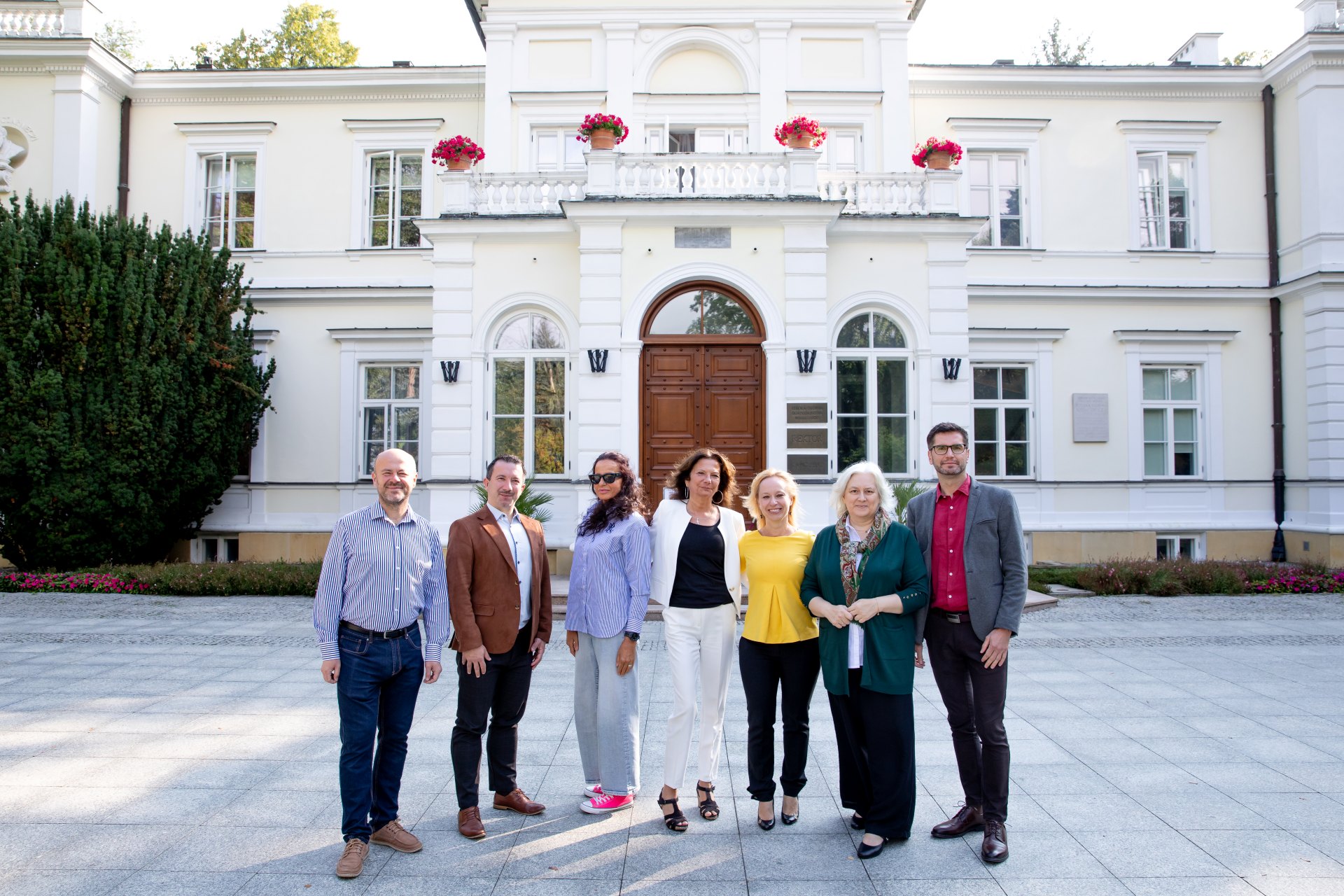
Winning the bid, however, was only the beginning. Organising an event expected to attract several thousand participants required a team bringing together different academic communities across Warsaw. On 28 October 2024, the first meeting of the Local Organising Committee (LOC) was held at the Rector’s Palace of the Warsaw University of Life Sciences (SGGW). The Committee brought together representatives of the University of Warsaw, Warsaw University of Life Sciences, Cardinal Stefan Wyszyński University, SWPS University, the Maria Grzegorzewska University, and Collegium Civitas. Professor Mirosława Grabowska, then President of the Main Board of the Polish Sociological Association, was appointed Chair of the LOC. Professor Joanna Wyleżałek (SGGW), Professor Julia Kubisa (University of Warsaw), and Dr Izabela Bukalska were appointed Vice-Chairs. Over time, more people joined the team, and today the LOC comprises more than thirty representatives of Warsaw universities.
From the outset, SGGW has played an important role in the preparations and, together with the University of Warsaw, will serve as one of the main hosts of the Congress. SGGW is represented on the LOC by a large group of academics. Alongside LOC Vice-Chair Professor Joanna Wyleżałek, the University is represented by Professor Agnieszka Kampka, Professor Urszula Soler, Dr Ewa Zaraś, Dr Małgorzata Herudzińska, Dr Wojciech Połeć, Dr Rafał Boguszewski, and Dr Konrad Burdyka. For four days in August, the campuses of SGGW and the University of Warsaw will welcome several thousand participants and become key meeting places for the European sociological community.
In 2025, preparations entered a new phase, with direct cooperation between the LOC and the ESA Executive Committee becoming increasingly important. On 1–2 April 2025, an eight-member ESA delegation visited Warsaw. The visit provided an opportunity not only to discuss the timetable and division of responsibilities, but also to see the venues where the Congress was to take place. The delegation visited the campuses of SGGW and the University of Warsaw and met with the authorities of both universities as well as members of the LOC. The meeting at SGGW was attended, among others, by the Rector of SGGW, Professor Michał Zasada; Vice-Rector for International Cooperation, Professor Marta Mendel; representatives of the University of Warsaw; and ESA representatives led by its President, Professor Kaja Gadowska. The visit marked an important step from general plans towards concrete organisational arrangements.
The next meeting took place on 6–7 October 2025. By then, discussions had become much more practical, focusing on conference facilities, logistics, the movement of participants between venues, and possible locations for accompanying events. The Warsaw Tourism Organisation and municipal institutions also became involved in the preparations. It was becoming clear that the Congress would not be confined to university campuses alone. Its participants would also have an opportunity to experience Warsaw and, for a few days, become part of the city.
On 6 March 2026, representatives of the ESA Executive Committee once again visited SGGW. With less than six months remaining before the Congress, preparations were already well advanced. What two years earlier had been primarily a shared idea of Warsaw sociologists had by then taken a very tangible form: a committee of more than thirty people, cooperation between several universities, the involvement of the city authorities, and, above all, the increasingly close prospect of welcoming several thousand researchers to Warsaw.
The 17th European Sociological Association Congress will take place on 25–28 August 2026. More than 3,000 scholars from Europe and other parts of the world are expected to attend. It will be one of the largest international academic events held in Warsaw in 2026, but also an undertaking that demonstrates how different academic communities can join forces around a common goal. The LOC has become a space for precisely this kind of cooperation – bringing together Warsaw universities, the Polish Sociological Association, the European Sociological Association, and the city’s institutions. Behind the four days of the Congress in August, therefore, lie almost three years of preparations, meetings, arrangements, and the collective work of many people.